
What to See in the Florence Duomo: Essential Details You Need to Know
Some cities are remembered for their streets, others for their cuisine, their history or their art — but Florence remains unforgettable for all of these reasons. Among its artistic and historical heritage, the Cathedral of Santa Maria del Fiore stands out as the iconic symbol of the Tuscan capital. If you haven’t visited it yet, here are the key details of the Florence Duomo you should know.
Discover the Details of the Florence Duomo
When you first see it while entering Piazza del Duomo, its grandeur can be overwhelming. But whether you visit with an audio guide or with an expert guide, you’ll soon discover that every corner of the Duomo has a story to tell. To help you prepare for your trip to Florence, here are some of the must-see details.
The Marble Façade Is Not the Original One
One of the most common misconceptions is that the Duomo’s current façade dates back to the same period as its construction. The cathedral began to be built in 1296 under the design of Arnolfo di Cambio, but the current façade was completed much later, between 1871 and 1887, in Neo-Gothic style by Emilio De Fabris.
For centuries, the original façade remained unfinished. In fact, it was removed in the 16th century, leaving the cathedral with a bare front until a final design was chosen in the 19th century through a public competition. The result is a harmonious blend of white, green and red marble, colours also present in other buildings of the complex such as the Baptistery and the Campanile.
This contrast between the ancient and the relatively modern gives the Duomo a coherent yet historically layered appearance that reflects the evolution of Florentine art over the centuries.
Measurements of Brunelleschi’s Dome
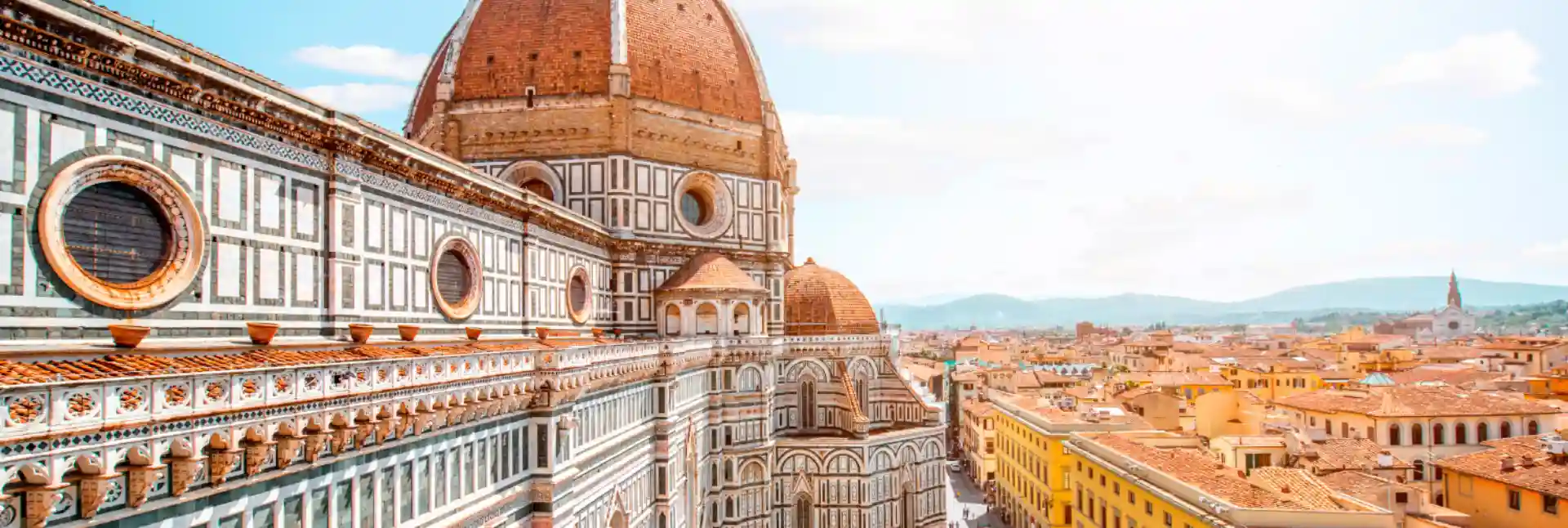
If there is one reason why the Florence Duomo is famous worldwide, it is its monumental dome. Designed by Filippo Brunelleschi and completed in 1436, it was the largest dome ever built at the time and remains the largest brick dome in the world.
The dome has a diameter of 45.5 metres and a total height from the cathedral floor to the lantern of approximately 114 metres. Its construction was a revolutionary technical challenge, as Brunelleschi designed a self-supporting double dome without the use of the massive wooden scaffolding normally required to sustain such a project.
This engineering achievement marked a turning point in Renaissance architecture. Climbing its 463 steps to reach the lantern is an unforgettable experience, offering a close look at the structure and unparalleled views of Florence.
The Last Judgment Frescoes
Inside the dome awaits one of the most breathtaking details of the Florence Duomo and one of the most impressive works of sacred art: the Last Judgment frescoes, a monumental 3,600-square-metre painting created between 1572 and 1579 by Giorgio Vasari and Federico Zuccari.
The frescoes take their name from the scene they depict: angels, saints, sinners, demons and Christ as the supreme judge at the centre. It is nearly impossible to miss despite the scale of the space, and taking time to observe the details is truly worthwhile. Their Mannerist style marks the transition from the Renaissance to the Baroque, displaying emotional intensity and dramatic expression.
Stained Glass Windows of Santa Maria del Fiore
The stained glass windows are another of the essential details of the Florence Duomo. There are 44 windows decorated with stained glass dating mainly from the 15th century. Most of them were designed by renowned Quattrocento artists, including Donatello, Lorenzo Ghiberti and Paolo Uccello.
These windows, of great artistic value, depict religious scenes from both the Old and New Testaments. The way the light filters through the coloured glass creates an atmosphere that changes throughout the day.
Paolo Uccello’s Liturgical Clock
A fascinating detail that often goes unnoticed by visitors is the liturgical clock above the main interior door. This clock was painted by Paolo Uccello in 1443 and follows the ancient system of the 24 Italic hours, where the day begins at sunset instead of midnight.
What makes it even more interesting is that the clock still operates using this system, and its hands move counter-clockwise. Besides its technical uniqueness, it is an artistic work decorated with the four Evangelists, reflecting the sacred perception of time during the Renaissance.
The Campanile and the Baptistery
Although not physically part of the cathedral, the Giotto’s Campanile and the Baptistery of San Giovanni are inseparable from the Duomo’s identity. Even though they are independent structures, they form a single architectural and spiritual ensemble.
The Campanile, standing 85 metres high with 414 steps, offers another spectacular perspective of the city and the cathedral, and its marble decoration follows the same pattern as the Duomo’s façade. The Baptistery, one of Florence’s oldest buildings, is famous for its Gates of Paradise designed by Ghiberti and its golden mosaic ceiling.
But Santa Maria del Fiore Has Much More to Offer…
These are just some of the many details that make the Florence Duomo a true open book of art history, architecture and Renaissance spirituality. Every stone, every work and every detail carries a deeper meaning that enriches the visitor’s experience.
Visit the Florence Duomo with tickets tailored to your needs and let us guide you so you don’t miss a single detail. Join us in discovering its best-kept secrets.