
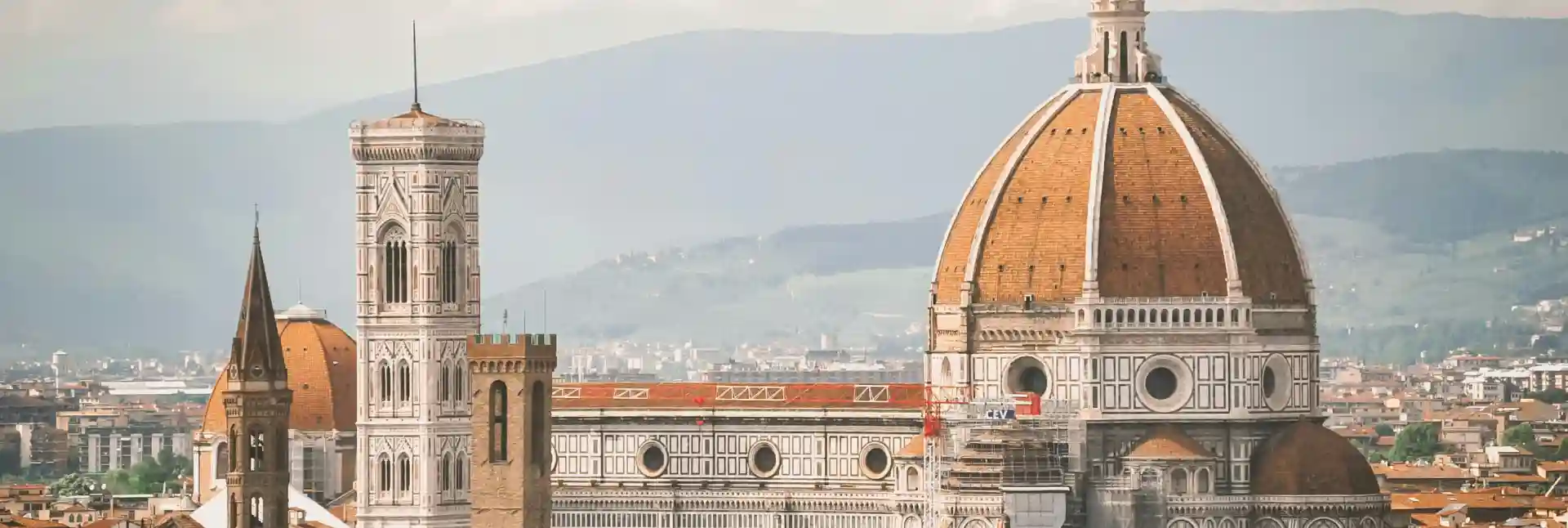
Brunelleschi’s Dome: discover the history of Florence Cathedral
The Brunelleschi Dome shapes the horizon of Florence, becoming the city’s ultimate icon, but it is also one of the greatest achievements of Renaissance architecture. This masterpiece changed the history of construction in Europe, and today thousands of travellers continue to marvel at this space within the Cathedral of Florence, a symbol of human ingenuity, faith and art.
Key facts about Brunelleschi’s Dome
It took years to figure out how to finish it
The construction of the Cathedral of Santa Maria del Fiore, the official name of the Duomo, began in 1296, but the process revealed a major problem: closing the drum of the central nave. A competition was launched so different architects could present their proposals, but at that time there was no known method capable of covering such a large space without columns or beams. Or so it seemed…
A goldsmith with no architectural experience appeared with an ingenious solution that seemed to solve the problem. And that person was Brunelleschi. How did he do it? We’ll tell you!
Self-supporting
The dome of Florence is, above all, a self-supporting dome, meaning it did not require scaffolding or temporary structures during its construction. This technique was not only unprecedented for its time but also extremely risky.
Brunelleschi designed a double-shell structure: an inner, heavier layer that supports the weight, and an outer, lighter layer, visible from the outside and responsible for protecting the structure. Both layers are connected by a complex network of beams and corridors.
This innovation made it possible to build the dome block by block without collapsing, reaching a height of 114 metres and becoming the largest masonry dome ever built.
Herringbone brick technique
One of the most surprising secrets of Brunelleschi’s Dome is the famous herringbone brick technique. This method allowed the bricks to stay in place without sliding as the dome of Florence Cathedral was being completed.
Brunelleschi realised that by placing the bricks at an angle, alternating them and following a specific pattern, the load was better distributed and there was no need for additional support structures during construction. This pattern also added lateral stability and prevented slippage—critical for such a steep structure.
Specific systems invented by Brunelleschi
Another great achievement by Brunelleschi was the creation of mechanical systems specially designed to lift materials to the highest parts of the dome. He used a system of pulleys, cranes and hoists with designs never seen before, including reversible gears that allowed materials to be lifted and lowered without dismantling the machinery.
These innovations made it possible to transport tons of stone and brick to heights never before reached in Florence. They also marked the beginning of a new era in architecture, influencing construction techniques across Europe for centuries.
Inspired by the classical world
Although revolutionary, Brunelleschi was deeply inspired by classical Roman architecture, especially the Pantheon of Agrippa. He travelled to Rome in his youth, where he spent years studying the ruins and construction techniques of the Empire. However, what he achieved in Florence surpassed even his models: the Pantheon has a dome of 43 metres in diameter, built with Roman concrete, while the dome of Florence, of similar proportions, was built with brick and stone.
The frescoes of the dome
Once the structure of the Florence Dome was completed, its interior remained undecorated for more than a century. It was not until 1572 that the decision was made to adorn this monumental space with a pictorial work worthy of its scale.
And who better than one of the leading artists of the time? Giorgio Vasari, a celebrated artist and architect, was chosen for this important task. He designed a monumental depiction of the Last Judgment, inspired by Michelangelo’s model in the Sistine Chapel. However, he did not complete the work, as he died in 1574, leaving only part of the fresco finished.
After his death, the project was continued by Federico Zuccari, a painter from Rome. He completed the frescoes following Vasari’s general design but introduced his own stylistic variations.
The impressive dome is therefore not the work of a single artist, but of two major figures of the time, resulting in a majestic ensemble covering more than 3,600 square metres, depicting a powerful and detailed vision of the Last Judgment.
Visiting Florence’s Duomo: an essential experience
Visiting Florence Cathedral and climbing Brunelleschi’s Dome is an unforgettable experience for anyone who loves history, architecture or art — but also for any traveller! From the top, you can enjoy incomparable views of the entire city and the magnificent Tuscan hills that surround it — a dreamlike landscape!
Discover Florence’s Duomo with tickets that include an audioguide or a guided tour and explore this impressive monument. Understanding its history in depth and seeing the construction techniques from within completely transforms the visit. Don’t miss the opportunity!